‌‌‌‌
‌

A Rovaniemi icebreaker day trip is doable, but it takes up most of the day because the cruise departs from Axelsvik in Swedish Lapland. The journey takes about 2 hours 15 minutes each way, leaving around 2.5 to 3 hours for the cruise, ship exploration, and sea-ice activities when conditions allow. The core experience is breaking through frozen sea, walking on ice, and floating in a survival suit. Your key choices are how you reach Axelsvik and which ship experience suits your day.

Overview

  • Travel time: From Rovaniemi, allow about 2 hours 15 minutes each way to Axelsvik. From Kemi, it is about 1 hour, and from Lulea, about 1 hour 15 minutes.
  • Time on the ground: Allow around 2.5 to 3 hours for the cruise itself, depending on your chosen ship experience.
  • What fits in a day: Icebreaking, ship exploration, sea-ice walking and survival-suit floating when conditions allow.
  • What's included / not: Both experiences include a 16-language guide, hot drinks and a Cruise and Swim certificate. Transfers vary by departure.
  • Best way to do it: Transfer from your base for simpler logistics to Axelsvik.
  • Ship choice: Choose a focused self-guided cruise or a longer experience with more ship access and guided exploration.
  • Should you stay overnight? No. The cruise works as a day trip from Rovaniemi, Kemi, or Lulea, although Rovaniemi makes it a longer day.

Should you do an icebreaker cruise as a day trip?

ApproachIs a day trip worth it?What this actually feels likeBetter alternatives

Focused icebreaker day: cruise + sea-ice activities

Yes, it's the best way to do it

About 2 hours 15 minutes each way to Axelsvik leaves around 2.5 to 3 hours for icebreaking, ship exploration, and sea-ice activities when conditions allow.

Best option as a day trip

Icebreaker with a longer ship experience

Yes, if you start early

The longer cruise gives you more time to explore the ship and onboard spaces, but the Rovaniemi transfer still makes this an 8.5-hour-plus day.

Choose a shorter cruise if time is limited

Icebreaker from Kemi or Lulea

Yes, if you are already based there

The shorter journey to Axelsvik reduces travel time, leaving more of the day around the cruise rather than on the road.

Base yourself closer to Axelsvik if the cruise is a priority

Self-drive to Axelsvik

Yes, if you have a car

You avoid scheduled transfers and control your arrival time, but you take on winter driving, parking, and check-in yourself.

Use a transfer if you prefer less logistics

Polar Explorer vs Arctic Explorer

Polar Explorer

  • Around 3 hour cruise: Spend longer onboard exploring the icebreaker and the frozen Bothnian Sea.
  • Explore all 7 decks: Includes a guided ship tour alongside the 16 language audio guide.
  • Icebreaker Theater: Watch the onboard film for more context on the vessel and its icebreaking operation.
  • Sea ice activities: Walk on the ice and float in a survival suit when conditions allow.
  • Onboard dining: Restaurant available during the cruise.
  • Best suited to: Visitors who want more time and depth onboard.
  • Recommended cruise: Polar Explorer icebreaker cruise

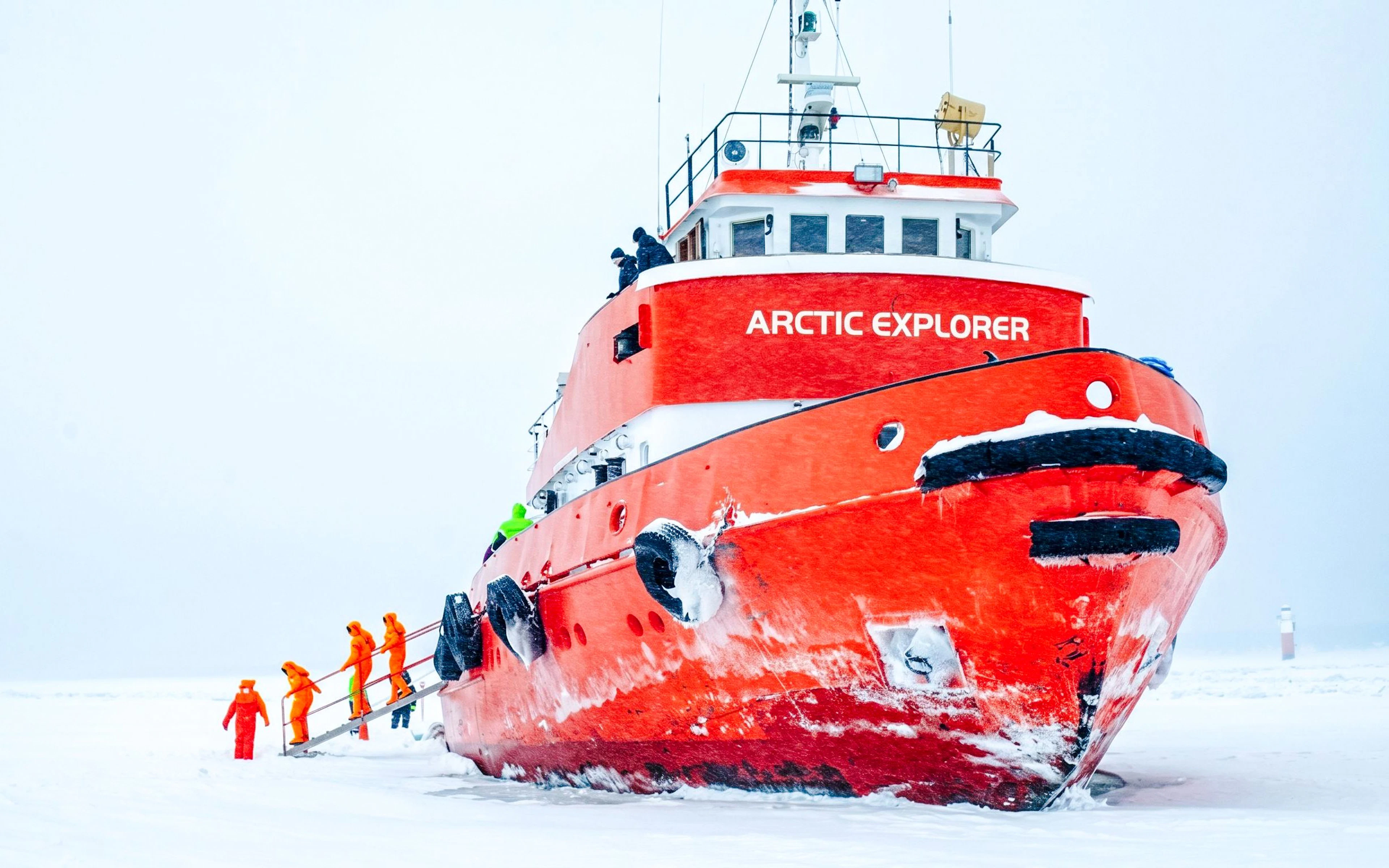
Arctic Explorer

  • 2.5 hour cruise: A shorter version focused on the core icebreaker experience.
  • Self guided exploration: Use the 16 language E Guidebook to explore the ship at your own pace.
  • Sea ice activities: Walk on the ice and float in a survival suit when conditions allow.
  • Onboard cafe: Grab a hot drink and warm up during the cruise.
  • Cruise and Swim certificate: Receive a certificate signed by the Captain.
  • Best suited to: Visitors who want the core experience in a shorter format.
  • Recommended cruise: Arctic Explorer icebreaker cruise

How to get to the icebreaker from Rovaniemi

By organized transfer from Rovaniemi

  • How it works: Scheduled shuttle from Rovaniemi pickup points takes you directly to the Axelsvik terminal in Swedish Lapland.
  • Time: About 2 h 15 min each way; around 8.5 hours total.
  • Tradeoff: Fixed pickup times and a long road journey.

By organized transfer from Kemi

Self-drive option

  • How it works: Scheduled shuttle from Kemi takes you to the Axelsvik terminal in Swedish Lapland.
  • Time: Around 1 hour each way; about 6 hours total.
  • Tradeoff: Fixed departure times and less flexibility than driving.

By organized transfer from Lulea

  • How it works: Scheduled transfer from Lulea takes you directly to the Axelsvik terminal.
  • Time: Around 1 h 15 min each way; about 6.5 hours total.
  • Tradeoff: Fixed departure times and transfer availability varies by product.

By self-drive to Axelsvik

  • How it works: Drive directly to the Axelsvik terminal, with free parking available at the Sweden-side terminal.
  • Time: Around 1 to 2 h 15 min each way, depending on your starting city and winter road conditions.
  • Tradeoff: You handle winter driving, navigation, border logistics, check-in, and the Sweden-Finland time difference.

What a Rovaniemi-to-icebreaker day actually looks like

Row of buses lined up for airport transfer service.
1/8

🚌 Hotel pickup and early start

The day often begins in the dark, with a coach collecting travelers from several hotels or city stops. At this stage, it still feels more like a transfer than an adventure. Jackets rustle, people settle in quietly, and the excitement is still mostly anticipation rather than payoff.

  • Time needed: 15–45 mins
  • Local tip: Keep gloves, hat, and your phone easy to reach, not buried in your bag, because the first real photo window comes fast once you arrive.

🌲 The long road to the port

This is the part many people underestimate. You’re seated for a long stretch, watching snowy forest, roadside light, and long open sections slide by. It can feel calm and cinematic, but it also means the day’s value depends heavily on what happens later on the ship.

  • Time needed: 1–2 hr 15 min each way
  • Local tip: Treat the transfer as part of the experience budget, not dead time you can ignore when comparing this with shorter Lapland tours.

🚢 First sight of the ship

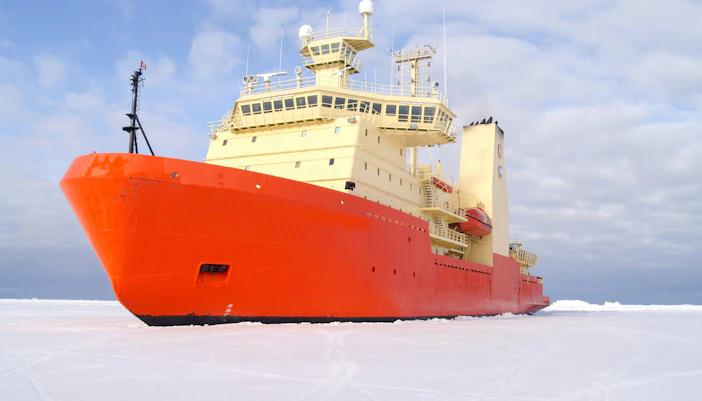
The mood changes quickly once the hull comes into view. Up close, the ship feels industrial rather than polished: heavy steel, broad decks, and a scale that photos rarely explain well. This is the first point where the product starts feeling rare rather than simply expensive.

  • Time needed: 15–30 mins
  • Local tip: Don’t linger too long in the staging area if deck access opens, early boarding usually gives you calmer first views.

❄️ Icebreaking underway

Once the ship starts pushing through the frozen sea, you feel the real point of the day. The sound is deep and mechanical, the deck vibrates underfoot, and the ice shifts outward in thick white slabs. This is not a scenic cruise with winter views in the background, it is an engineering spectacle first.

  • Time needed: 45–75 mins
  • Local tip: Step outside early for the cleanest deck view, then return indoors later once more people realize this is the best part to watch.

🛠️ Decks, interiors, and onboard downtime

Between outdoor moments, you move through decks, interior rooms, and ship spaces that make the day feel more structured. On richer variants, this may include guided deck access, a cinema, or restaurant space; on simpler ships, the indoor experience is thinner. The contrast between warm interiors and sharp deck air is part of the rhythm all day.

  • Time needed: 30–60 mins
  • Local tip: If you picked a flagship ship, use the indoor segments properly, they are part of what you paid extra for.

👣 Walking on the frozen sea

When conditions allow, stepping down onto the sea is the moment the day shifts from watching to participating. The surface feels stranger than many expect: solid, bright, wind-exposed, and much more open than a snowy path on land. It is one of the clearest “I am really here” moments of the entire trip.

  • Time needed: 20–40 mins
  • Local tip: Don’t assume this is guaranteed in early winter, treat it as a bonus delivered by safe conditions, not a promise.

🛟 Survival-suit floating

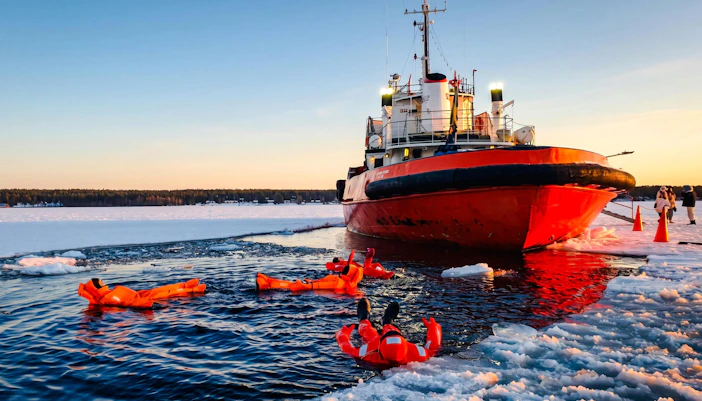
Floating is the signature memory for many visitors. You’re sealed into a thick insulated suit, lowered into near-freezing water, and then left surprisingly buoyant rather than overwhelmed by cold. It feels more controlled than extreme, but the emotional payoff is huge because the scene looks so implausible from the outside.

  • Time needed: 10–20 mins in the water, plus rotation time
  • Local tip: If floating is your main reason for booking, ask early how groups are rotating so you’re not caught off guard by a later slot.

☕Certificate, and the long ride back

After the hero moments, the day settles. This is when people warm up, compare photos, collect certificates, and finally feel the fatigue from the road time. The return ride can feel noticeably longer than the morning transfer because the adrenaline drop is real.

  • Time needed: 45–90 mins, plus the return transfer
  • Local tip: Keep a snack and power bank for the return, because your energy usually dips after the floating segment, not before it.

Best time for a Rovaniemi to icebreaker day trip

SeasonMonthsWhat it’s likeCrowdsBook ahead

Peak

December–February

Deep winter conditions and the clearest frozen-sea feel. Expect early pickups, busier boarding waves, and the most pressure on floating rotations.

High, especially Christmas and school-break weeks

2–6 weeks minimum

Shoulder

November and March

November has fewer departures and possible weak-ice conditions; March brings longer daylight and easier deck visibility.

Moderate to High

1–2 weeks usually works; March weekends book faster

Off-peak

April

Tail-end season with lighter demand, but more variability around ice quality and sea-ice walking.

Low to Moderate

Same-week can work, but verify operating dates first

How to prepare & make the most of your Rovaniemi to icebreaker day trip

Man placing a power bank into a black backpack indoors.
  • Passport or valid ID: You are crossing into Sweden for the cruise.
  • Warm clothing: You will move between heated indoor areas and exposed ship decks.
  • Warm, grippy shoes: Useful on the ship and around the icy terminal areas.
  • Power bank: Cold temperatures can drain phone batteries quickly during photos.
  • Small bag: Easier to manage during transfers and in the ship's narrower onboard spaces.
Young woman booking online with a banking card and smartphone.
  • Book ahead: Allow around 2 to 6 weeks, especially for December to March travel.
  • Choose your ship: Check whether you want the 2.5 hour self guided cruise or the longer 3 hour experience with guided 7 deck access.
  • Check transfers: Rovaniemi, Kemi and Lulea have different transfer options and journey times.
  • Check conditions: Sea ice walking and floating depend on ice thickness, sea conditions and safety.
  • Check departure time: Swedish local time applies at Axelsvik.

Local tips

  • Plan around the full day: From Rovaniemi, the experience can take around 8.5 hours including transfers, not just the 2.5 to 3 hour cruise.
  • Check the sea-ice activities: Walking on the ice and floating depend on ice thickness, sea conditions and safety.
  • Keep warm layers accessible: You will move between the ship's heated areas and cold outdoor decks.
  • Check early-season conditions: Sea-ice walking may not be available until the ice is thick enough.

Frequently asked questions

No. Both experiences depart from Axelsvik in Swedish Lapland, on the Swedish side of the Bothnian Sea. Rovaniemi is a transfer starting point, with the journey to Axelsvik taking about 2 h 15 min each way. Check how to get to an icebreaker cruise.